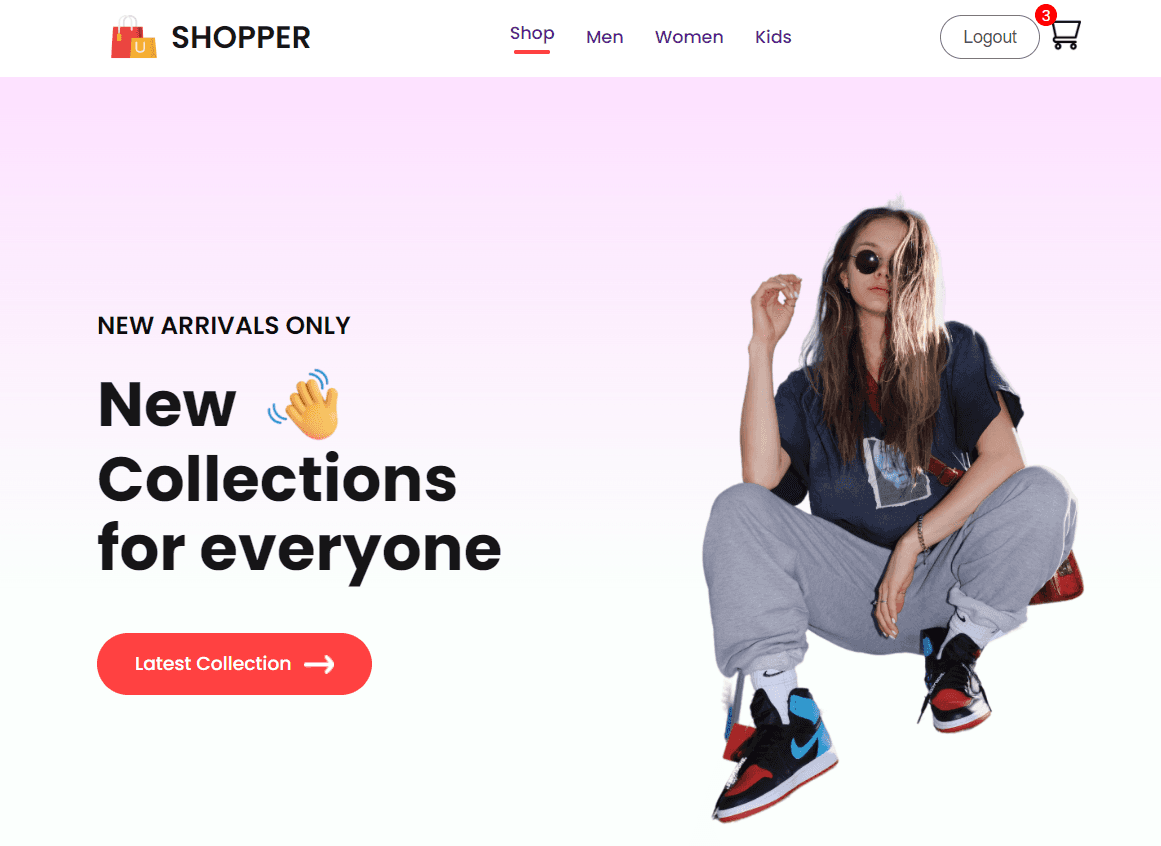
"A complete end-to-end clothing e-commerce solution."
Shopper is a full-stack retail e-commerce website designed to provide a seamless shopping experience for users, while also offering a robust admin dashboard for complete inventory management.
Problem Statement
"Retail e-commerce requires massive scale."
A clothing store has entirely different requirements than a food delivery app. A food delivery app focuses on real-time speed. A clothing e-commerce platform focuses on catalog management, product variations, inventory tracking, and complex filtering.
The challenge was to build a system that didn't just handle a few items in a cart, but could manage an entire digital retail store from both the customer and admin perspectives.
The Challenge
- 👗 Vast Product Catalogs — Efficiently rendering and filtering large amounts of clothing items without slowing down the frontend.
- 🎛️ Inventory Management — Building a secure admin dashboard where store owners can add, edit, or remove products effortlessly.
- 🛒 Persistent Shopping Cart — Ensuring that a user's cart remains intact across sessions using robust database structures.
- 🔐 Dual Authentication — Managing completely different authorization levels for standard shoppers versus store administrators.
The Solution
"Meet Shopper — The digital retail storefront."
To solve these challenges, I built a highly scalable MERN stack application divided into two distinct parts: the customer-facing storefront and the backend admin panel.
Browse → Filter → Add to Cart → Checkout
- Customer Storefront — A clean, visually appealing UI where users can easily find clothing by category and manage their cart.
- Admin Dashboard — A secure, dedicated portal for uploading product images, setting prices, and managing the overall inventory.
- Robust Authentication — JWT-based security to ensure that only authorized admins can modify the store's database.
- Scalable APIs — RESTful endpoints designed to quickly serve product data to the frontend, even as the catalog grows.
Shopper bridges the gap between a beautiful customer experience and powerful backend management.
Technology Stack
"A scalable retail architecture"
Frontend:
React.js drives the dynamic UI, allowing for instant filtering and seamless navigation between product categories without reloading the page.
Backend:
Node.js + Express.js forms the backbone of the application, handling complex business logic, admin validation, and API routing.
Database:
MongoDB was chosen for its flexibility in handling highly variable product schemas and storing complex cart data.
A traditional, battle-tested MERN stack configuration built to handle e-commerce traffic.
The Shopper Story
"The 'One More Project' that solidified everything."
After I finished building Tomato, I had a functional, impressive project on my resume. But as I looked at the job market, a familiar feeling crept in.
"Is this enough? Should I build just one more?"
I realized that while Tomato taught me how to handle real-time state and complex cart mechanics, I still hadn't built a classic, retail-style e-commerce platform with a fully functional Admin Dashboard.
I wanted to prove to myself that I could build an application that had two completely different user experiences: one for the customer, and one for the business owner.
So, I turned back to YouTube for inspiration.
🏗️ CHAPTER 01 — THE FOUNDATION
"Building with confidence."
When I started StudyNotion, I was completely lost. When I started Tomato, I was figuring things out.
But when I started Shopper, something was different. I actually knew what I was doing.
I found a great tutorial to guide the structure, but this time, I wasn't just blindly copying code. I was anticipating the instructor's next move. I knew exactly why we needed a specific MongoDB schema, and I already understood how JWT authentication was going to lock down the admin routes.
Shopper wasn't about learning the basics—it was about mastering them.
👕 CHAPTER 02 — THE RETAIL CATALOG
"Managing products at scale."
Building a clothing store means dealing with data. A lot of data.
Categories. Men's wear. Women's wear. Kids. New collections.
I had to design a frontend that could cleanly display all of these products without feeling overwhelming. I focused heavily on React component reusability. Instead of writing separate code for every category page, I built a dynamic product grid that could instantly filter and render the correct items based on the API response.
🎛️ CHAPTER 03 — THE ADMIN DASHBOARD
"Empowering the business owner."
This was the most exciting part of the project.
In my previous apps, I managed data directly through the database. But for Shopper, I built a completely separate Admin Panel.
I created a secure portal where an admin could log in, upload new clothing images, set prices, assign categories, and instantly push new products to the live store.
Seeing a product that I added through my own custom dashboard instantly appear on the customer-facing frontend was incredibly satisfying. It made the application feel like a complete, real-world product.
🚀 CHAPTER 04 — THE FINAL POLISH
"Solidifying the stack."
Shopper was exactly what I needed it to be.
It was the project that finally made the MERN stack feel like second nature to me. It wasn't my most experimental project, but it was easily my most solid.
By building Shopper, I proved that I could take an established architectural pattern—the e-commerce store—and execute it flawlessly from start to finish.
The project that finally made me feel ready.