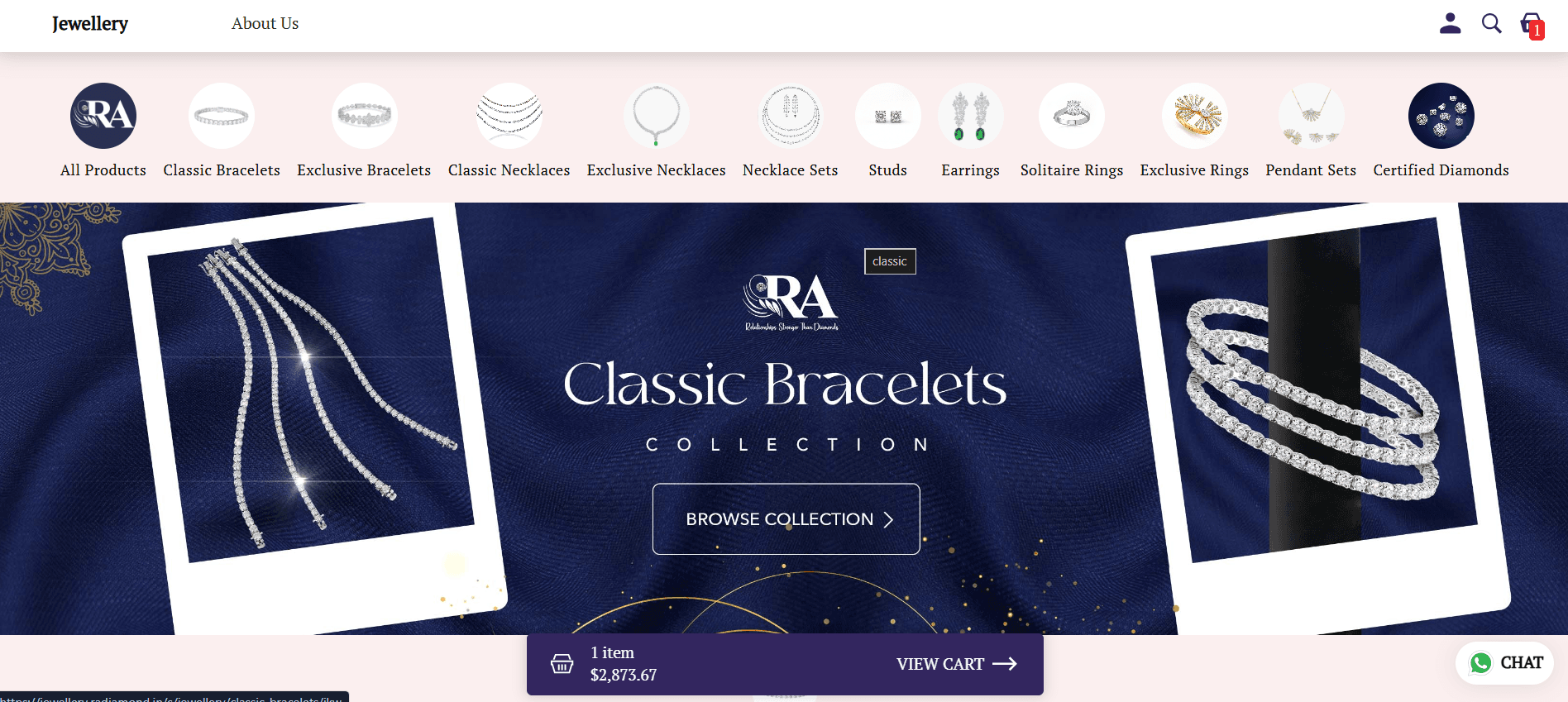
"Crafting a high-end digital storefront."
Jewellery UI is a frontend design exploration for a luxury e-commerce brand. Built entirely with React and TailwindCSS, the focus of this project was on crafting a visually stunning, responsive, and highly accessible user interface that feels as premium as the products it showcases.
Problem Statement
"Luxury demands a premium digital experience."
When selling high-end luxury products like jewellery, the website cannot look like a standard e-commerce template. The digital experience needs to mirror the physical experience of walking into a luxury boutique.
The challenge was to build a frontend that didn't just display products, but presented them with elegance.
The UI needed to be flawless.
The interactions needed to be subtle and smooth.
The Challenge
- 💎 Visual Aesthetics — Using spacing, typography, and color palettes to create a high-end luxury feel without making the UI look cluttered.
- 📱 Flawless Responsiveness — Ensuring the intricate design translated perfectly from large desktop monitors down to mobile screens.
- ⚡ Performance — Rendering high-quality imagery and smooth hover animations without sacrificing load times or frame rates.
The Solution
"Meet Jewellery UI — Where code meets elegance."
I designed and developed a frontend experience that prioritized aesthetics and smooth user interactions.
Discover → Admire → Select → Purchase
- Premium Interface — A clean, minimalist design language that lets the product photography take center stage.
- Fluid Animations — Subtle hover states, smooth page transitions, and elegant micro-interactions that elevate the browsing experience.
- Responsive Grid System — A carefully crafted layout that perfectly scales high-resolution product grids across all devices.
- Modern Component Architecture — Built entirely with reusable React components, making the frontend highly scalable and maintainable.
Jewellery UI isn't just a store—it's a digital showroom.
Technology Stack
"A frontend built for speed and beauty."
Frontend:
React.js powers the component architecture, allowing for a fast, dynamic, and highly interactive user experience.
Styling:
TailwindCSS was heavily utilized to create the custom, pixel-perfect design system without writing bloated CSS files. Utility classes allowed for rapid prototyping of complex luxury layouts.
A modern, lightweight frontend architecture focused purely on the user experience.
Deployment & Infrastructure
"Showcasing to the world."
Frontend — Vercel
The application is deployed on Vercel, ensuring ultra-fast global delivery, lightning-quick load times, and continuous deployment capabilities.
Hosted for performance, ensuring the luxury experience never lags.
The Jewellery Story
"The freelance pitch that became a portfolio piece."
Not every project starts with a grand vision. Some start with a phone call.
A friend of mine reached out to me with an exciting opportunity. He had a connection with a client who was looking to build an e-commerce platform for their high-end jewellery business. They needed a developer, and my friend recommended me.
This was potentially my first major freelance gig. I was thrilled.
But I knew that just telling the client "I can build it" wasn't going to be enough. I needed to show them.
I needed a pitch they couldn't say no to.
🎨 CHAPTER 01 — THE PITCH
"Building a digital showroom in record time."
I didn't wait for the official contract. I decided to build a high-fidelity frontend prototype to present to the client during our meeting.
I wanted them to see their vision come to life before we even signed any paperwork.
I dove deep into UI/UX research for luxury brands. I studied how companies like Rolex, Cartier, and Tiffany & Co. structured their websites. It was all about minimalism, perfect typography, and letting the products breathe with massive amounts of white space.
I spun up a React project, installed TailwindCSS, and started coding the UI.
⚡ CHAPTER 02 — THE DEV SPRINT
"Translating luxury into CSS."
Building this frontend was a masterclass in CSS for me.
Usually, when I build applications, my focus is heavily on the backend, state management, and APIs. But for this project, the design was the product.
I spent hours tweaking padding, adjusting the tracking of fonts, and perfecting the hover states of buttons. I learned that in luxury design, less is always more. Every border, every shadow, and every animation had to serve a purpose.
By the end of the sprint, I had a fully responsive, incredibly smooth frontend prototype ready to show the client.
🚪 CHAPTER 03 — THE CLOSED DOOR
"When things don't go according to plan."
The day of the pitch arrived. I was ready. The UI looked amazing.
But... business is business.
For reasons outside of my control, the freelance project ended up falling through. The client decided to go in a different direction, and the deal was off.
At first, I was disappointed. I had put a lot of passion and late nights into building that prototype.
💎 CHAPTER 04 — THE SILVER LINING
"A failed pitch, but a massive win for my skills."
The freelance gig might not have happened, but I quickly realized something important:
I had just built one of the best-looking frontends I had ever coded.
The code was mine. The experience was mine.
I took the prototype, polished it up, and turned it into a standout piece for my portfolio.
Building Jewellery UI taught me how to bridge the gap between engineering and high-end design. It proved to me that I could build production-ready, visually stunning interfaces under pressure.
The freelance project didn't happen, but the skills I gained were permanent.