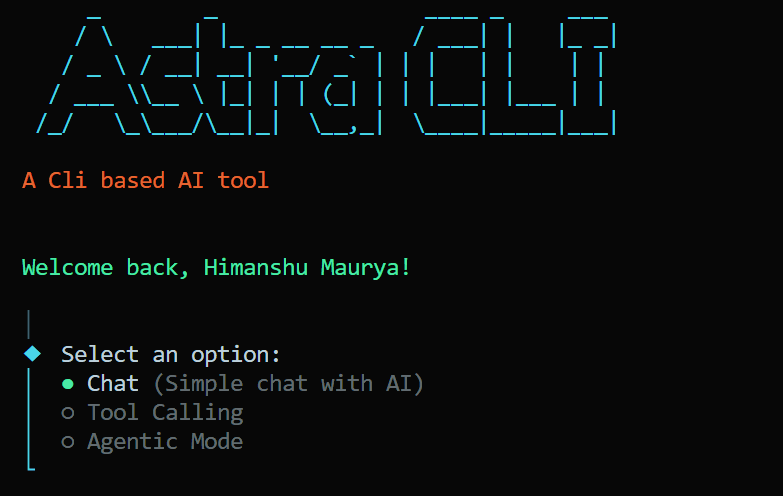
"Bringing the power of Agentic AI directly to the terminal."
AstraCLI is an advanced, AI-powered Command Line Interface designed for developers. It goes far beyond a simple chat wrapper by introducing Tool Calling and Agentic Mode, allowing the AI to autonomously execute commands, fetch data, and accelerate your workflow without ever leaving the terminal.
Problem Statement
"Context switching kills productivity."
As developers, the terminal is our home. But whenever we need to ask an AI a complex question or generate boilerplate, we have to break our flow, open a browser, switch to an AI platform, copy the code, and switch back.
But it’s not just about chatting. Standard AI models are trapped in a text box—they can't interact with your local environment or fetch real-time external data on their own.
The gap was clear:
Developers need AI where they work.
AI needs tools to actually be useful.
The Challenge
- 🧠 Context Management — Efficiently managing token limits and conversation history in a text-only interface.
- 🛠️ Tool Calling Integration — Creating a bridge that allows the language model to trigger and execute actual functions in the real world.
- 🤖 Agentic Reasoning — Building a loop where the AI can think, act, observe the result of its action, and decide what to do next without human intervention.
- 🔐 Security & Auth — Protecting the CLI with robust authentication to ensure only authorized users consume the API limits.
The Solution
"Meet AstraCLI — Your terminal's new brain."
AstraCLI integrates the cutting-edge AI SDK into a lightweight, powerful command-line application.
Prompt → Think → Call Tool → Execute → Respond
- Standard Chat Mode — Instantly query the LLM for code explanations, debugging help, and general knowledge.
- Tool Calling Mode — The AI dynamically decides if it needs to trigger external functions (like searching the web or checking system stats) to answer your prompt accurately.
- Agentic Mode — The AI takes the wheel. Give it a high-level goal, and it will autonomously use multiple tools in sequence to achieve that goal.
- Secure Architecture — Built with Better-Auth and Prisma to manage user sessions and securely store encrypted API keys.
AstraCLI isn't just an interface—it's an autonomous developer assistant.
Technology Stack
"Built for the future of software."
Core AI:
AI SDK forms the backbone of the application, handling the complex streaming of text, tool calling protocols, and LLM communication.
Backend Engine:
Next.js & Express.js serve the robust API endpoints required to handle authentication and secure model requests.
Database & Auth:
Prisma ORM combined with Better-Auth provides incredibly secure and type-safe session management and user tracking.
A cutting-edge stack designed to handle the complexities of modern AI applications.
The AstraCLI Story
"Chasing the excitement of the AI revolution."
AI is everywhere. You can't open Twitter or YouTube without hearing about LLMs, "Agents," or "AGI."
For a while, I was just a consumer. I was using ChatGPT like everyone else. But as a developer, simply using the tool wasn't enough for me. I wanted to know how it was built. I wanted to know what made an "Agent" different from a standard chatbot.
I didn't build AstraCLI because I needed a project for a resume or an assignment. I built it out of pure, unadulterated excitement.
I turned to YouTube, fell down a massive rabbit hole on the AI SDK and agentic workflows, and decided I was going to build my own AI tool directly in the terminal.
🤖 CHAPTER 01 — BEYOND THE CHATBOX
"The AI Awakening."
Getting a basic chat interface to work in the terminal was cool, but it was just the beginning.
I learned how to connect the AI SDK, stream the response back chunk by chunk, and format it nicely in the command line. It felt great to ask my terminal a question and watch it type out the answer.
But it was still just a parrot in a cage. If I asked it for the current weather, or to check my local files, it couldn't do it. It was completely blind to the outside world.
That’s when I discovered the true power of LLMs.
🛠️ CHAPTER 02 — GIVING THE AI HANDS
"Mastering Tool Calling."
An LLM generates text. That’s all it does.
But what if you tell the LLM: "Here is a list of tools you have access to. If you need to use one, just return its name and the arguments."
This concept—Tool Calling—blew my mind.
I spent hours on YouTube figuring out how to implement it. I wrote JavaScript functions that could fetch real-world data, and I exposed those functions to the AI.
The first time I asked AstraCLI, "What's the weather in Tokyo?" and watched the AI autonomously pause, execute my custom weather-fetching function, read the result, and formulate a perfect response... it was magic.
I had given the AI hands.
🧠 CHAPTER 03 — LETTING GO OF THE STEERING WHEEL
"Entering Agentic Mode."
Tool calling was incredible, but it was still a one-step process. I asked a question, it used a tool, it answered.
I wanted to push it further. I wanted Agentic Mode.
I learned how to build an agent loop: a system where the AI thinks, calls a tool, observes the output, and then decides on its own if it needs to call another tool before answering the user.
Building this loop was incredibly complex. If the logic was flawed, the AI would get stuck in infinite loops, calling the same tool over and over. I had to learn how to manage system prompts and strict execution limits carefully.
But when I finally gave AstraCLI a complex, multi-step command and watched it autonomously chain three different tools together to solve the problem... I knew I had built something special.
🚀 CHAPTER 04 — A GLIMPSE INTO THE FUTURE
"What AstraCLI taught me."
AstraCLI started purely as a passion project fueled by excitement, but it fundamentally changed how I view software engineering.
It taught me that the future of development isn't just about writing logic—it's about writing systems that can reason and execute logic autonomously.
I didn't just build a CLI tool. I built a bridge between my terminal and the cutting edge of artificial intelligence.
The project that taught me how to stop chatting with AI, and start building with it.